Organizational Behavior Change Training
We created this practitioner training program for teams that need behaviors to actually change in day-to-day work
✔ Diagnose adoption barriers using behavioral science
✔ Design and test interventions on your actual change
✔ Build permanent diagnostic capability in your team
Who trains with us
Primary teams we train
• Change & transformation teams
• HR/People teams working on culture and leadership behaviour
• OD / L&D teams supporting adoption beyond training completion
• Innovation teams
We also adapt the training programs for:
• Digital health & product teams
• Government & policy teams
What your team leaves with
By the end of the programme, your team will be able to:
Clear definitions of the key behaviors your change depends on (not “adoption” as a vague outcome)
Use engagement intentionally as a mechanism, not a calendar of meetings
A diagnosis of what’s blocking those behaviors in real work, with evidence behind it
A reusable toolkit and a repeatable way of working your team can apply on the next initiative
Design targeted behavioral interventions linked to the diagnosed barrier.
Embed and sustain change by shaping context and culture
How this programme is different
This programme is for when the plan exists, but behavior still isn’t changing consistently in day-to-day work.
We teach a behavioral change approach that helps teams identify what’s blocking behaviors (in the workflow, environment, norms, and individual), then provide our recommended strategies for them to ideate solutions on.
If your team has already done other change trainings, our training will work as a strong complement, with behavioral science as a core competency to add to their toolbox.
How we train: The SHIFT method
SHIFT is our diagnostic and strategy methodology. It's how we systematically find what's blocking adoption and design targeted strategies to fix it.
Specify the behavior (who does what, in what context)
Hypothesize what’s blocking it
Intervene with the right lever for that barrier
Facilitate the approvals and reinforcement needed
Test quickly, learn honestly, scale what works
SHIFT is grounded in behavioral science, design and change. Made for practitioners.
How is the program structured
Your team learns a practical behavioral approach to change: how to define the behavior you need, diagnose what’s blocking it, design interventions that fit real work, and embed change through stakeholders, context, and culture.
This is a 6 Week program and uses a mix of theory, interactive sessions and a case study.
Each session is 2.5 hours
This program can be done in person, online or hybrid.
Pre-Flight
We scehdule interviews and a survey with your team to understand your context and the main change challenges you are working through. We take this information to contextualize the barrier and strategy cards, as well as the case study.
Week 1: Introduction to Behavioral Science (Foundations)
Focus: What behaviour is (and what it isn’t), and how to define it in context.
Session objectives
Introduce behavioral science principles and how they support change work.
Distinguish observable behaviours from non-behaviors.
Workshop
Define behavior precisely using ABC framework
Create a behavioral map for your initiative
Outputs
Behavior definitions for your initiative (initial draft)
A “behavior map” of where adoption must happen
Week 2: Behavioral Diagnosis (Foundations)
Focus: Diagnosing why the behavior isn’t happening
Session objectives
Introduce and use a behavioral model for diagnosis
Identify barriers in change contexts
Workshop
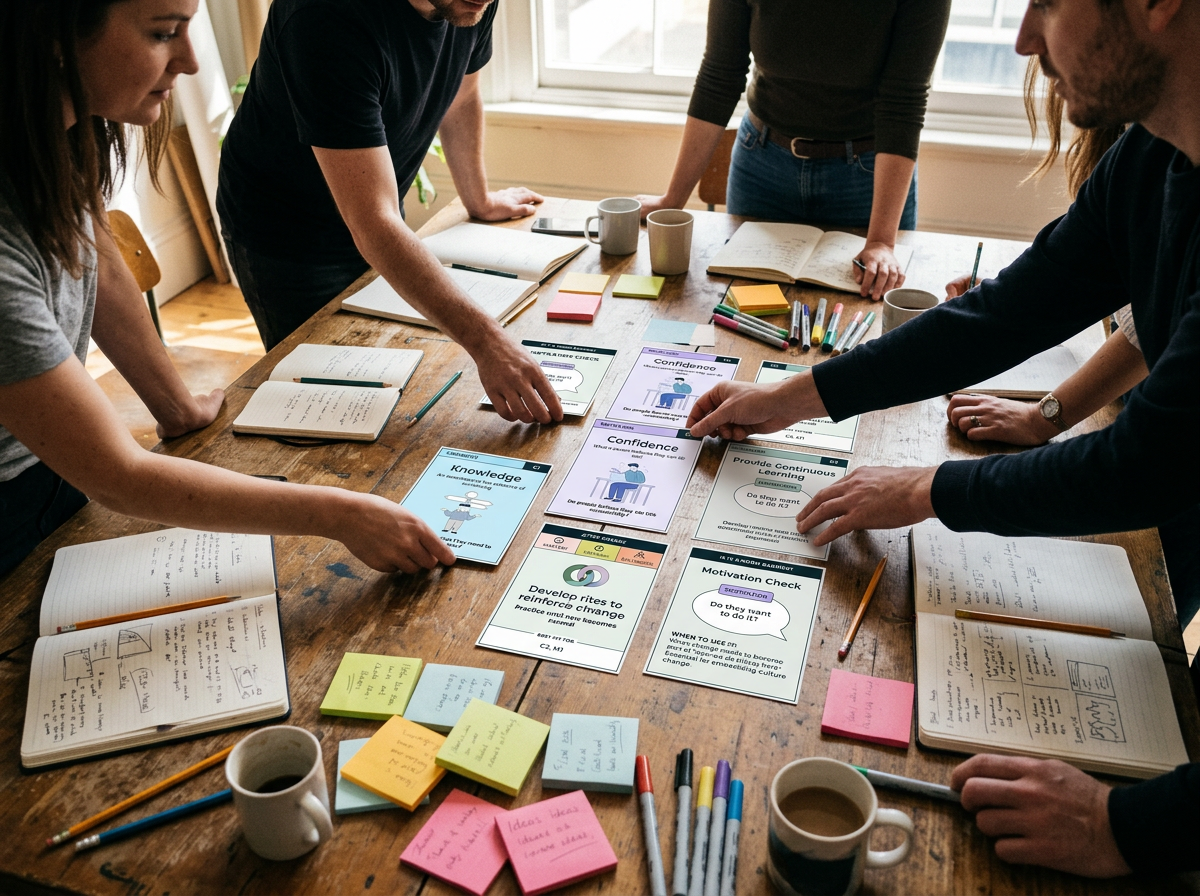
Classify barriers with our barrier cards
Design a simple approach to collect and classify barriers
Outputs
Barrier hypotheses for your priority behaviors
An evidence based plan (what to check, where, with whom)
Week 3: Designing Behavioral Interventions (Foundations)
Focus: Matching interventions to barriers (instead of defaulting to only comms/training)
Session objectives
Introduction to behavior change strategies and how they link to barriers
Use practical intervention strategies
Workshop
Turn your barrier diagnosis into a small set of interventions with our intervention cards
Strengthen interventions using behavioral principles
Outputs
2–4 intervention briefs (what changes, where it shows up in work, who owns it)
Draft “pilot-ready” assets (prompts, checklists, workflow changes, routines)
Week 4: The Psychology of Change (Deep dive)
Focus: Motivation that actually sustains behavior at work, and the role of norms
Session objectives
Understand key motivation factors, meaning, mastery and belonging
Understand social norms in the workplace
Workshop
Diagnose the motivation/norms element of your case and adjust interventions accordingly
Use Motivation and Norm strategies developed by our behavioral science team
Outputs
Motivation and norms insights linked to specific behaviours
Intervention refinements (what to add/remove to make the behavior feel easier/safer/more normal)
Week 5: Stakeholder Engagement (Deep dive)
Focus: Engagement as behavior change: getting the right approvals, reinforcement, and follow-through
Session objectives
Psychology of engagement and its role in change
Choosing engagement techniques for different stakeholders
Workshop
Identify engagement barriers and constraints in your initiative
Build an engagement plan tied to specific behaviors (not generic messaging)
Outputs
Stakeholder and influence map for your initiative
Manager/sponsor strategies that support adoption without relying on enforcement
Week 6: Shaping Context and Culture (Deep dive)
Focus: Embedding: what needs to change in the environment, routines, and cultural signals so the behavior holds.
Session objectives
Context and implementation
Organisational culture through a behavioral lens
Behavioral Risk
Evaluation
Workshop
Identify cultural artefacts, values, and assumptions that support or block the target behaviour. Syllabus_The Science Of Behavio…
Align behavioural and organisational change dimensions (so interventions can survive delivery). Syllabus_The Science Of Behavio…
Outputs
Context/culture risks and enabling conditions for sustainment
Embed plan: what needs to be exist (structures, routines, feedback loops)
Present a complete behavioral change strategy for the initiative, with peer/expert feedback
Frequently asked questions
Is this a public programme with set dates?
No. This is delivered privately to one organisation at a time, for internal teams. We contextualize it and scheduled around your team and your initiative.
Who is it for?
• Change & transformation teams
• HR/People teams working on culture and leadership behaviour
• OD / L&D teams supporting adoption beyond training completion
• Innovation teams
We also adapt the training programs for:
• Digital health & product teams
• Government & policy teams
How many people should attend?
Most teams run it with 12–20 people.
What’s the weekly time commitment?
Live sessions: 2.5 hours per week for 6 weeks for the online training. For Hybrid and In-Person we can discuss with you how best timings will work.
How does pricing work?
It’s priced as a team programme, not per person. Price depends on team size, delivery format (virtual/on-site), and whether you want add-ons (clinics, special playbooks). We’ll give you a clear proposal with scope and outputs.
What’s included (materials)
SHIFT toolkit and templates (behavior definitions, diagnosis cards, intervention cards), case walk-throughs, post-programme implementation clinics (optional) to review what gets deployed and adjust.
About us
Aim For Behavior is a consultacy focused on organizational change and transformation. We are behavioral scientists, anthropologists, designers and practitioners with a deep understanding of how behavior changes inside systems.
Founded by Robert Meza, we are based in Amsterdam, we work globally with start-ups, private sector companies and governments around the world.
Our mission is to make change practical and achievable, by designing the conditions that make adoption succeed
Trainings are done with Robert and a team of behavioral scientists.