The AFBSHIFT Method
A practical behavioral method for teams working on change and transformations. AfBSHIFT helps you pinpoint what’s blocking the critical behaviors, and designs evidence based strategies that match the real constraint, not the assumed one
You get faster clarity, fewer generic activities, and interventions that hold up in real workflows
Why we built AfBSHIFT
In many change and transformations, the default response to adoption is to add more: communications, training, senior sponsorship, escalation.
But we kept seeing that the critical behaviours still weren’t happening in day-to-day work. Many times the issue were mis-diagnosed and did not look at problems in the workflow, environment, norms, or perceived risk.
SHIFT is the method we use to find the real constraints and then design tools and strategies that actually fix them.
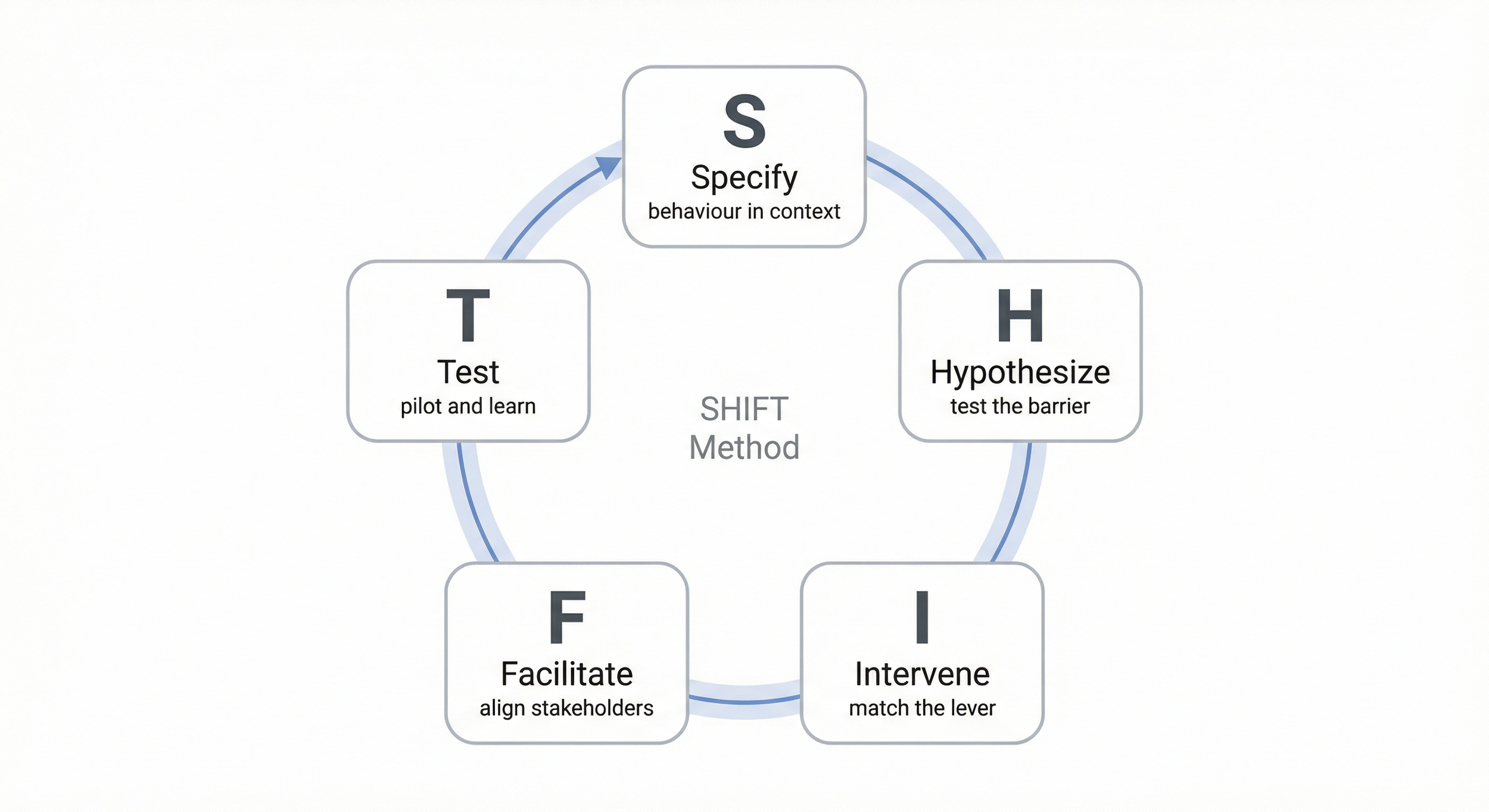
Specify the Behavior
Why this matters
Adopting the new system or way of working isn’t a behaviour, it’s an outcome. Diagnosis only becomes possible when you specify the concrete actions people must take in real work.
We look at the behaviors in context:
Actors: who needs to do it
Behaviours: the observable action
Context: when/where it happens
Instead of being vague
Employees need to adopt the new CRM or need to speak up in meetings
We get specific
Sales reps enter contact notes within 24 hours of each customer meeting, including next steps and follow-up date.
In practice
A financial services client said people aren’t using the platform. We translated that into 5 behaviours, focusing only on those that had the most constraints.
Hypothesize (Diagnose the barriers)
We use behavioral models to find what’s blocking the behaviours:
Can they do it (knowledge, skill, clarity, cognitive load)?
Does the environment make it possible (workflow fit, tools, time, access, social norms)?
Does it feel worth it (meaning, risk, incentives, habit, identity)?
Why this matters
When things get stuck, leadership often assumes the issue is motivation (“resistance”) and respond with more messaging. SHIFT checks whether the real problem is about knowledge or the system, because comms won’t a system that gives incentives for the old behaviors.
In practice
An change initiative rollout was stuck at 45% adoption
We found:
Users knew what was going on
The had the tools to do it
The lacked the confidence, the internal why (purpose) as well as the support to move forward
The fix wasn’t more training. It was clarifying the purpose and helping them to internalize the change, giving people choices and creating a sense of belonging
How we test hypotheses
Observation, barrier-focused interviews, workflow mapping, friction audits, and comparing where/when the behaviour does happen versus doesn’t.
Intervene
We match the fix to the diagnosed barriers.
Why this matters
The most common mistake in change is creating good strategies for the wrong barriers, whicn end up not working and creating cynicism.
Our approach
We draw on evidence-based behaviour change and implementation strategies to map the right barriers to the right interventions, we contextualize these to the projects, so they are not just generic, but purpose made.
Facilitate Stakeholders
Even the best intervention fails if it can’t get approved, resourced, prioritised, or reinforced. Executives, middle managers, IT, compliance—HR, Product, everyone involved has their own constraints.
SHIFT applies the same lens to stakeholder behavior:
Who must approve, prioritise, resource, or reinforce this?
What’s blocking them (risk, incentives, workload, exposure, misalignment)?
What would make support easier and safer?
In practice
A healthcare client kept projects in “review” for too long, our diagnosis showed middle managers were blocking because the change would make performance more visible to executives.
The barrier wasn’t disagreement, it was fear of exposure. We redesigned reporting to show team trends rather than individual metrics.
Common stakeholder barriers
Risk aversion, competing priorities, unclear decision rights, fear of blame, lack of peer support, low confidence in the implementation plan.
Test and Iterate
Pilot, measure behaviour change, adjust, then scale what works.
Context matters, there is not one size fits all. A strategy that works in one team may fail in another.
That’s why SHIFT pilots before scaling, and measures behavior, not sentiment.
What we measure
Not: “Are you satisfied with the training?”
Not: “Do you understand why this matters?”
Instead:
Did the behavior happen
Did it happen well
Did it sustain after the push
Did workarounds reduce
Was the intervention implemented as designed
SHIFT in delivery
Small pilot → observe behavior → adjust → prove → scale.
Want to build this capability in-house?
We run a 6-week Behavioral Change Practitioner Programme where your team learns AfBSHIFT by applying it to your live organization change challenges.
You leave with progress on the initiative now—and the capability to run this approach without us next time.
The program includes:
6 weeks of facilitated working sessions with your team
A live diagnosis on your change challenges (behaviors + constraints)
Intervention designs and a pilot-ready plan
AfBSHIFT toolkit and templates
Post-programme implementation clinics to support rollout
Have a change that’s not working as expected?
Tell us what’s not working. We’ll tell you whether SHIFT is a fit and what a diagnostic engagement would look like.